Empower
Educators

01·Behaviour & Classroom Culture

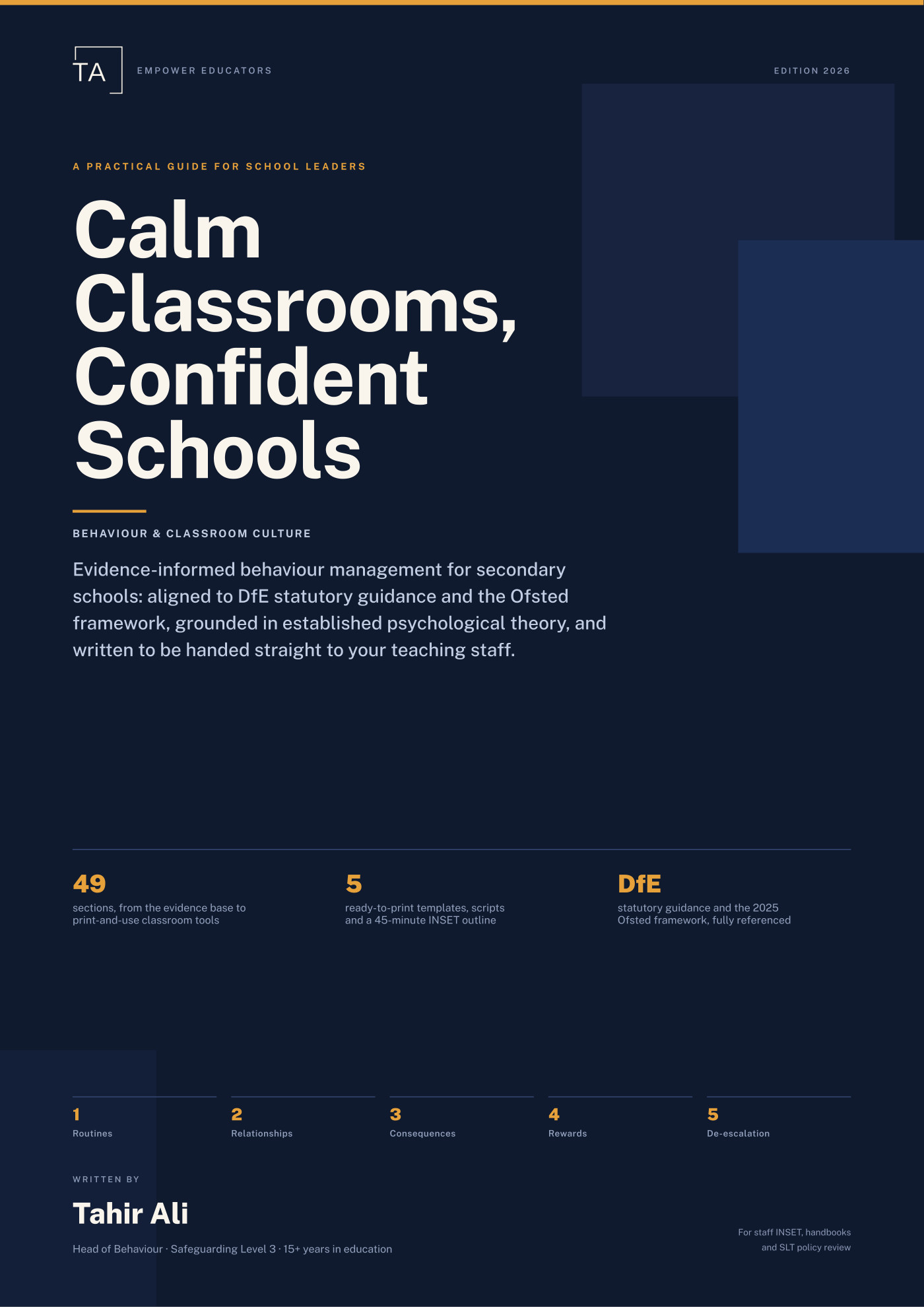
Calm Classrooms,
Confident Schools

Evidence-informed behaviour management for secondary schools: aligned to DfE statutory guidance and the Ofsted framework, grounded in established psychological theory, and written to be handed straight to your teaching staff.

  1. 1Routines
  2. 2Relationships
  3. 3Consequences
  4. 4Rewards
  5. 5De-escalation
Download the PDF

52 pages · 49 sections · 3.8 MB

Cover of Calm Classrooms, Confident Schools

Since November 2025, Ofsted's report-card framework has judged schools against nine separate evaluation areas, and attendance and behaviour is one of them in its own right — graded on its own line rather than folded into a general impression of ethos.

This booklet brings together the statutory guidance, the psychological theory that actually underpins good practice, and the scripts and systems that turn theory into a Tuesday-period-4 reality. It is written to be read cover to cover by senior leaders, then handed chapter by chapter to every member of teaching staff.

Written to
DfE statutory guidance & the 2025 Ofsted framework
Intended for
For classroom practice, staff INSET and SLT policy review
Extent
52 pages · 49 sections

·Look inside

Real pages, straight from the PDF

Click any page to see it full size.

·Contents

All 49 sections

Taken from the booklet's own contents page, so the page numbers are the real ones.

THE CASE

01Foreword — Why Behaviour Is the Foundationp3
02The National Picture: What the Data Showsp4
03Where the Problem Is Actually Coming Fromp5
04The Policy Framework: DfE, Ofsted & the Lawp6
05What Ofsted Actually Looks For on Behaviourp7

THE THEORY

06Part I — How Behaviour Is Learnedp8
07Part II — Needs, Systems & Traumap9
08Part III — Relational Practicep10

THE PRACTICE

09The Five-Pillar Framework, at a Glancep11
10Pillar 1 — Consistency & Routinesp12
11Pillar 2 — Relationships Firstp13
12Pillar 3 — Clear, Predictable Consequencesp14
13Pillar 4 — Recognition & Rewardsp15
14Pillar 5 — De-escalation & Co-regulationp16
15The Anatomy of an Incidentp17
16The Scripts: What to Say in the Momentp18
17When the Scripts Fail — Escalation Matrixp19
18When It Becomes a Safety Incidentp20
19Managing Low-Level Disruptionp21
20When Consistency Becomes Coldnessp22
21Myths vs Factsp23
22SEND & Inclusive Behaviour Managementp24
23Staff Wellbeing & Support Structuresp25
24Parents as Partnersp26
25The Ten Most Common Mistakesp27
26The Framework in Practice — Scenarios Ip28
27The Framework in Practice — Scenarios IIp29

FOR LEADERS

28Implementation Roadmap — the full yearp30
29The 30–60–90 Day SLT Launch Planp31
30Measuring What Actually Changedp32
31Make This Your School’s Own Policyp33
32Questions Leaders Actually Askp34
33Twelve Questions to Sit Withp35

THE TOOLKIT — PRINT & USE

34Template 1 — Individual Behaviour Planp36
35Template 2 — Ten-Minute Consistency Walkp37
36Template 3 — Termly Data Reviewp38
37The Lanyard Cheat Sheetp39
38The 45-Minute INSET Workshopp40
39Staffroom Poster — One-Page Summaryp41
40SLT Self-Audit Checklistp42

CLOSING

41In Closing — The Adults Are the Curriculump43
42Referencesp44
43Why I Wrote Thisp45

THE UAE CHAPTER — A STANDALONE SECTION

44The Framework You Actually Work Insidep46
45What the Code of Conduct Asks of Youp47
46The Five Pillars in an Emirates Classroomp48
47Making It Survive the Summerp49
48What a UAE Inspector Looks Forp50
49Students of Determinationp51